
Tapestries-73 | Beaches
In the aftermath of the massacre.


On Sunday evening, two men went to Bondi Beach in Sydney to kill Jews. The victims included a ten-year-old girl, a rabbi, and a holocaust survivor. Others have written (and will continue to write) more eloquently about these people and the human suffering than I can. So what follows is not a meditation on grief or shock, but an examination of predictability, warning signs ignored, and a failure that extends well beyond those in office.
For the last two years, Australia’s Jewish community and its leaders have been unequivocal: the normalisation of antisemitic rhetoric would lead to attacks on Jews, escalating until something truly horrific happened. While some listened, not enough cared, and here we are. The Australian community, especially in Sydney, is finally expressing some public solidarity with its Jewish community. But it came at great cost. In many ways, it feels like the price of admission into the collective Australian consciousness was a river of Jewish blood. To quote the provocative and accurate title of a chillingly good book, people love dead Jews.
In the aftermath, there has been an outpouring of anger directed at Australia’s politicians. This outpouring is justified and the scorn is deserved. Fifteen Australians were murdered (and over forty injured) on their watch in circumstances that Jewish Australians had predicted and articulated to anyone who would listen. It’s a reasonable position to take that with better leadership and a different response to the rising threats, this massacre could have been avoided. But to be blunt, asking people like Anthony Albanese, Penny Wong or Tony Burke to show anything resembling leadership is like asking an elephant to do a backflip. It’s more likely to flail its trunk and shit itself than to get off the ground.
Australia’s current leaders are just painfully, almost comically, average. They are political operatives, not leaders, and their defining skill is not moral clarity or courage but attunement. Over the past two years, the obvious task for our leaders was to confront incitement against the Jewish community, and to respond forcefully, in both rhetoric and action, to repeated acts of antisemitic violence. Instead, our leaders calibrated their responses to the electorate, chose political expediency, and optimised for the path of least personal cost. Anthony Albanese’s unwillingness to confront Islamic extremism, delivered through meandering rhetoric from behind a podium, stands in stark contrast to John Howard’s meeting with gun owners in rural Victoria, in a bulletproof vest, as he pushed through gun reform despite significant opposition within his party and base.
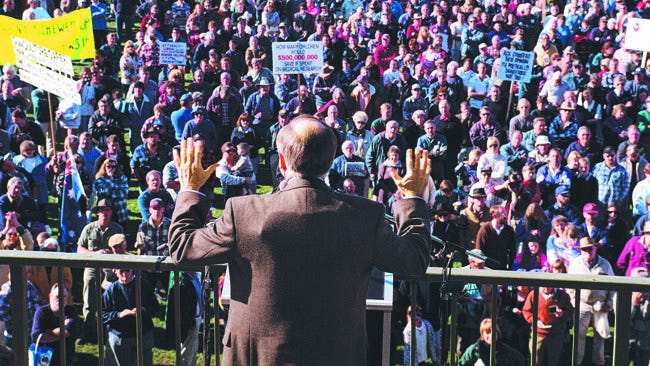
But the failure here does not sit with politicians alone. It reflects the vacuum they were operating in. The broader Australian public failed to engage with antisemitism loudly or seriously enough to create any political pressure at all. To this point, the response of most of the country to the escalating antisemitism in its backyard has been indifference, discomfort, and at best, private messages of solidarity. Where what’s at stake is Jewish lives and continuity as Jewish Australians, I’m more than happy to point the finger at the non-Jewish community and tell them it’s just not good enough. Given the lack of response from the broader Australian community, our political leaders did exactly what they are incentivised to do: next to nothing of consequence.
Part of the problem is that Australians have steadily outsourced civic responsibility altogether. We have come to believe that all problems are technical problems, to be managed by government, experts, and process, rather than moral challenges that demand public engagement, pressure, and self-examination. While “taskforces”, “recommendations” and “inquests” are all welcome, they are simply the manifestations of what’s become an overly dominant bureaucratic muscle. Said another way, we don’t need more processes, we just need non-Jewish Australians — in addition to our leaders — to give enough of a shit. When danger arises, instead of taking on civic and cultural responsibility, we wait for institutions to act so that we do not have to. In doing so, we confuse governance with citizenship, prefer rules and compliance over responsibility, and end up with a weak political class and an electorate unwilling to fill the void.
Australia likes to talk about values, but we have remarkably few that are clearly defined. We invoke mateship, a fair go, and camaraderie as if they are moral principles, when in reality they are outputs of a comfortable way of life rather than values that guide difficult choices. Social cohesion and multiculturalism seem to function as our core values, but neither tells us what to do when cohesion itself is under strain. Confronting antisemitism seriously, naming its sources, and grappling with its consequences would have required discomfort, conflict, and moral confrontation, things that directly challenge our sacred stability. So when faced with the choice between honesty and “harmony”, Australia chose “harmony”, or at least “harmony” for the 99.5% of the population that isn’t Jewish. We preserved the appearance of cohesion by avoiding the reckoning that grappling with antisemitism would have required. But in doing so, we allowed the danger to grow, and instead of a confrontation, we’ve been left with a calamity.
Australia’s founding myth was forged on a beach called Gallipoli, but it was a beach more than fifteen thousand kilometres from Sydney, over a century ago, in a war fought on behalf of a foreign empire. The ANZAC spirit was born in death far from home, and has long allowed us to anchor our national identity in sacrifice that occurred elsewhere. Last week, fifteen Australians were massacred on a beach that sits at the very centre of Australia’s consciousness. They were not soldiers, and they were not defending an empire or a cause. They were doing what Australians are told defines us: living freely, openly, and together. Death on a far-flung shore is woven into our mythology. Death in our backyard is not (yet).
The choice now is not abstract. This moment will either be managed, smoothed over (see: gun control), and folded back into Australia’s need for order and stability, or it will force a reckoning with who we are, what we stand for, and what our values demand when comfort is no longer an option. As Josh Frydenberg said, the Jewish community is fighting for its future in Australia. There is little more for our community to say that hasn’t already been said. The responsibility now sits with the rest of the country — its leaders and its people — to decide whether this was an aberration, or a final warning that cannot be ignored.
Love and appreciate you as always
Heartfelt as always and a beautiful call to action. The point about gun control made me realize that what I want in my leaders is not to build a technocracy (which was my assumption before), it’s moral courage to do unpopular stuff.
Thanks for writing this and sending you guys lots of love.