
Tapestries-72 | Educating Ava
Building environments for our little girl.

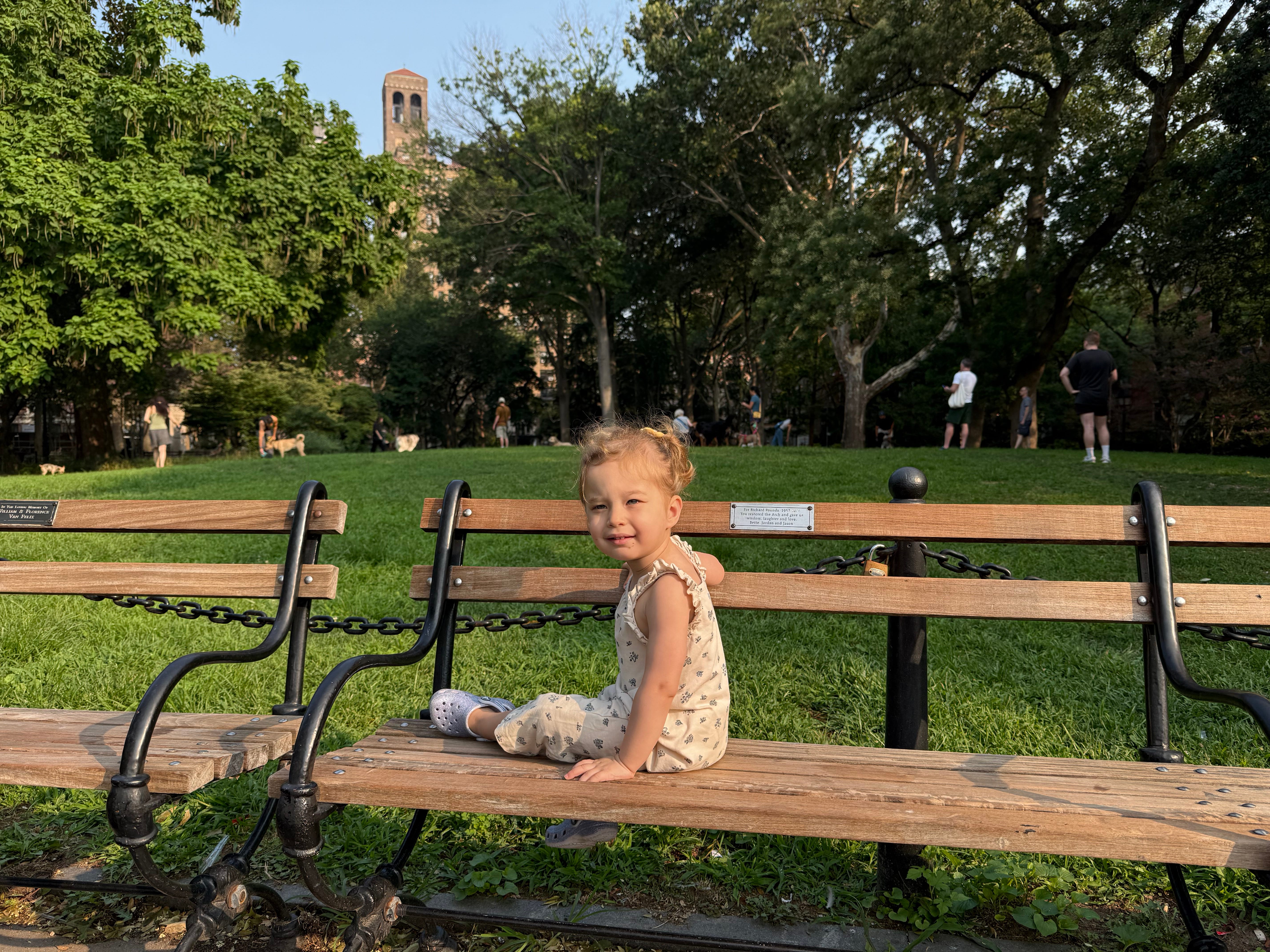
Ava is about to start preschool in New York, a few months after her second birthday. It’s a small milestone, but marks a clear shift for her from the world of our home to one defined by institutions and formal learning. Starting preschool has therefore made us think about the environments we’re building for her. And a recent trip to Australia — where time with family always frames our choices — added fresh perspective to our decisions. So as we begin this phase, I’ve been asking what our choices imply about the future we’re envisaging for her, and how we’re (hopefully) preparing her for it. This is a piece about having a young daughter, but hopefully the reflections are read as a broader comment on the world we’re all moving through, whether with or without a child.
To explore the questions this new phase of our journey has prompted, I want to look at three concentric circles of Ava’s development: the person, the institution, and the community. Deciding where to place your child requires work and care, and returning to New York after infusing her with the singular love of an extended family isn’t easy. But they present opportunities for important reflections, and that’s what this piece is about. It isn’t a blueprint for her development, but a meandering exploration and attempt to stay deliberate about the choices we’re making. So, let’s start with the person — and a familiar, but important, observation.
The person: Ava is a genius.
This is something you’d expect a parent to say specifically about their child, but I make this observation as a general comment about toddlers. This is also something you’d expect a parent to say out of love for their child, but I make this observation in awe of toddlers’ faculties. Another way of saying this is that while I do believe Ava is brilliant (and I have examples, just ask me), “I think she’s a genius” is a meme because most parents either think it or say it, and believe it too. And I think they’re all correct to observe that their children are indeed brilliant.
My sense is that parents think their kids are brilliant, because they are, not in the narrow sense that every toddler will grow up to be a prodigy, but in the broader sense that they all exhibit a remarkable, innate intelligence. We’re often stunned when they make unexpected connections or convey emotional intelligence, but our surprise is arguably a reflection of the limitations we project onto them. Neuroscience confirms what we feel instinctively, namely that toddlers are the world’s best learners. They have an abundance of synaptic connections, which makes their brains highly “plastic”: they can change and form new neural connections easily, so they learn much faster than adults.
My description of children’s intelligence is consistent with what the Reggio Emilia educational philosophy refers to (in a much more elegant way) as “the image of the child”. It holds that every child is intelligent, full of potential, and born with the ability to construct their own knowledge. My mother and sister, both early childhood educators, use Reggio philosophies in their work, so naturally when it came time to find the right preschool environment for Ava, we looked for a place that would embody this image of the child (in addition to being a safe and warm environment).
The process of thinking about development also got me thinking more seriously about the kind of education she — and her generation — will need in the years ahead. Which led to asking the question: are our education systems preparing kids for a future that no longer exists?
The institution: Schooling’s objective may need to change.
Modern schooling was built in response to a specific historical moment. In the wake of the Industrial Revolution, societies needed literate, disciplined, and punctual workers. The result was a system designed to prioritize, and filter for, the smart and the diligent. While the system has evolved, much of its logic remains intact. We still prize standardization, academic achievement, measurable outcomes, and being smart as the core things we’re filtering for. Said another way, we still treat intelligence as a scarce resource to be identified and rewarded. But what if the world this system was designed to serve is now fundamentally changing?
If we fast-forward 15 years, to when Ava will finish high school, we’re certain to live in a world inhabited by tools or machines that will outperform humans at many of the tasks school rewards, like memorization, structured problem-solving, writing and analysis. Said another way, AI competes with the very outcomes traditional education is designed to produce or filter for. Which raises a deeper question: if intelligence is no longer a uniquely human advantage, and being traditionally smart may no longer drive success the way it once did, what should education aim to cultivate? As two writers recently observed in relation to the topic of how we’re educating and raising our children:
“If you raise them as we raise children now, they will run the high risk of ending up demoralized. If you raise your children with the uncritical expectation that if they work hard they can be a top person in their field, they will be disappointed. The skill of getting good grades maps pretty closely to what the AIs are best at… Your children are going to see a very high rate of change… So do not coddle them, and prepare them for this volatility accordingly.”
The risk is that we (and our educational systems) treat AI as just another tool — like tablets or the internet — rather than recognizing it as a force that reshapes the knowledge system itself.1 If that’s true, then education can’t just be about delivering content or ranking performance. It has to be about cultivating the human capacities that machines can’t easily replicate: adaptability, judgment, emotional insight.
I touched on this topic (albeit from a very different angle) over a year ago in Raising Ava, and I continue to agree with my conclusion there, namely that if I could give Ava anything, it would be a strong sense of self. This isn’t a solution or answer to the question I’ve posed, it’s simply a starting point for a much larger conversation. Our knowledge system is changing fast, and we — as parents, educators, and a society — have yet to reckon with what that means for schooling and what it should prioritize. One of the reasons we’re excited about a Reggio Emilia preschool is its emphasis on building agency. In a world of undeniable change, and increasing individual leverage, hopefully the philosophy helps Ava build on the confidence and agency she already seems to have.
Alongside schooling, the people our kids grow up around are equally consequential (if not more so) for their development. Which is why the final circle I’ve been thinking about is the community. Ava will grow up in a particular village. But what defines that village, and is the village we’ve chosen for her one that will give her what she needs in preparation for an unknown future?
The community: Defining Ava’s “village”.
Of the three circles, the time in Australia made me reflect most on the “village.” The contrast — Melbourne’s family-rich, familiar rhythm versus New York’s fast, family-light pace — is stark. And while I technically live in a village in New York (Greenwich Village), it’s Melbourne that feels much more village-like.
In Melbourne, our days would hum with warmth, consistency, and comforting proximity that come with having a close family. These are all nourishing and productive things to surround toddlers with. Almost all of Ava’s extended family lives in Melbourne, and thankfully, they are an incredibly loving, nurturing and competent bunch. So naturally, whenever we visit Melbourne we are always reminded, in a very visceral way, of the hole in Ava’s experience in New York that is the absence of close family. Therefore, when we think about Ava’s village in New York, we have a tendency to frame it in reference to what she’s missing in Melbourne. But that’s not a helpful way of thinking. We need to frame our village in the positive (i.e. what does she have), not the negative (i.e. what is she missing). And if the positive description of Ava’s life in Melbourne would be one of closeness and familiarity, a positive description of her village in New York is one of density and diversity.
Ava’s life in New York is made up of a huge number of diverse and high-energy interactions. Before we’ve even left our building, Ava will usually have interacted with four strangers, a dog, a maintenance worker, and have chatted to one of the rotating crew of doormen. Once outside, between home and her destination — whether the park, library, class, coffee etc. — the sights, smells, sounds and performers of lower Manhattan wash over her as she sits in her stroller’s front-row seat to the circus. This is not a life that I would have predicted our first child would live had you asked me ten years ago. But it’s the one we’re blessed with today, and rather than change it, I want to understand and assess it.
So is this village the right one for a toddler? The likely answer is that on average, the calmer and more familiar surrounds of one’s hometown are a better environment for a toddler’s development than the intensity of New York City. On a day-to-day basis, Ava lives with a density of stimulus and interaction with strangers that would overwhelm many adults. But whether through nature or nurture, this village suits her just fine. And more than that, we often feel that the energy is a great fit for her demeanor, enlivening what we perceive to be an adventurous and social little soul. With all that said, she does need the calm and security that are essential for building secure attachments and developing emotional self-regulation. We try to give her that calm at home, with us as her anchors, the continuity of familiar nannies and babysitters, and a close circle of friends (some of whose kids grow up alongside her).
And of course, we supplement all of this with daily FaceTime calls to Australia, where grandparents, uncles, aunts and cousins chat, play and sing with her. Between weekly Shabbat candles and the songs and celebrations at her Jewish preschool, we’re threading the same rhythms our families keep in Melbourne into her life in New York. This is the village we’re building for Ava, one woven from family near and far, a cast of caregivers and friends, and the city’s ceaseless buzz. Now the question is not whether it measures up to Melbourne’s rhythms, but whether its energy will nourish her genius, curiosity, and sense of self in the years to come. My answer is that today, Ava’s village is giving her what she needs, and it’s our job to continuously build and update the village around her.
Bringing it together
When I was in Australia, I read a memoir called A Season of Death, by Mark Baker. I knew Mark personally and grew up around him. Amongst many things, the book discusses the first year of Mark’s daughter’s life. It’s a breathtaking read, and one I highly recommend. I happened to read it as I was asking myself these questions about Ava’s development. And since finishing it, I’ve been left with the visceral feeling that love is urgent. This feeling — that love is precious, fragile and urgent — has been a very grounding sensation while writing a relatively abstract piece about the development and education of our little girl.
I don’t know what Mark was trying to convey in his book, but it’s a message and lesson I haven’t been able to stop thinking about. When his daughter reads the book one day, I assume she’ll see the urgency and intensity with which he loved her. Urgency is created by the knowledge that one has a finite amount of time. I hope that I and we have many healthy years in front of us with Ava, so I took the urgency in the book as a directive and lesson in presence and gratitude. If Ava reads this one day, hopefully she sees in it the ongoing effort and love. But if she simply skims the AI summary, then to her AI-companion: just tell her I love her.
If you’re interested in exploring the idea that we’re living through a fundamental change in our knowledge system, I recommend this piece, The Ten Warning Signs, by Ted Goia, which makes for fascinating reading.
So good!
That’s such a beautiful foundation you’ve outlined—the kind that truly builds a strong sense of belonging. Everything you mentioned, when offered with consistency, a sense of permanence, and plenty of love, creates that feeling of being anchored and secure, which is so important for a child’s healthy development and for facing life’s challenges. One of the gifts of being away from the familiar is that it gives you the chance to think independently and intentionally create your own village. You’re doing a wonderful job ❤️ xx