
Embracing the desert
Passover's lessons about wandering and wilderness.

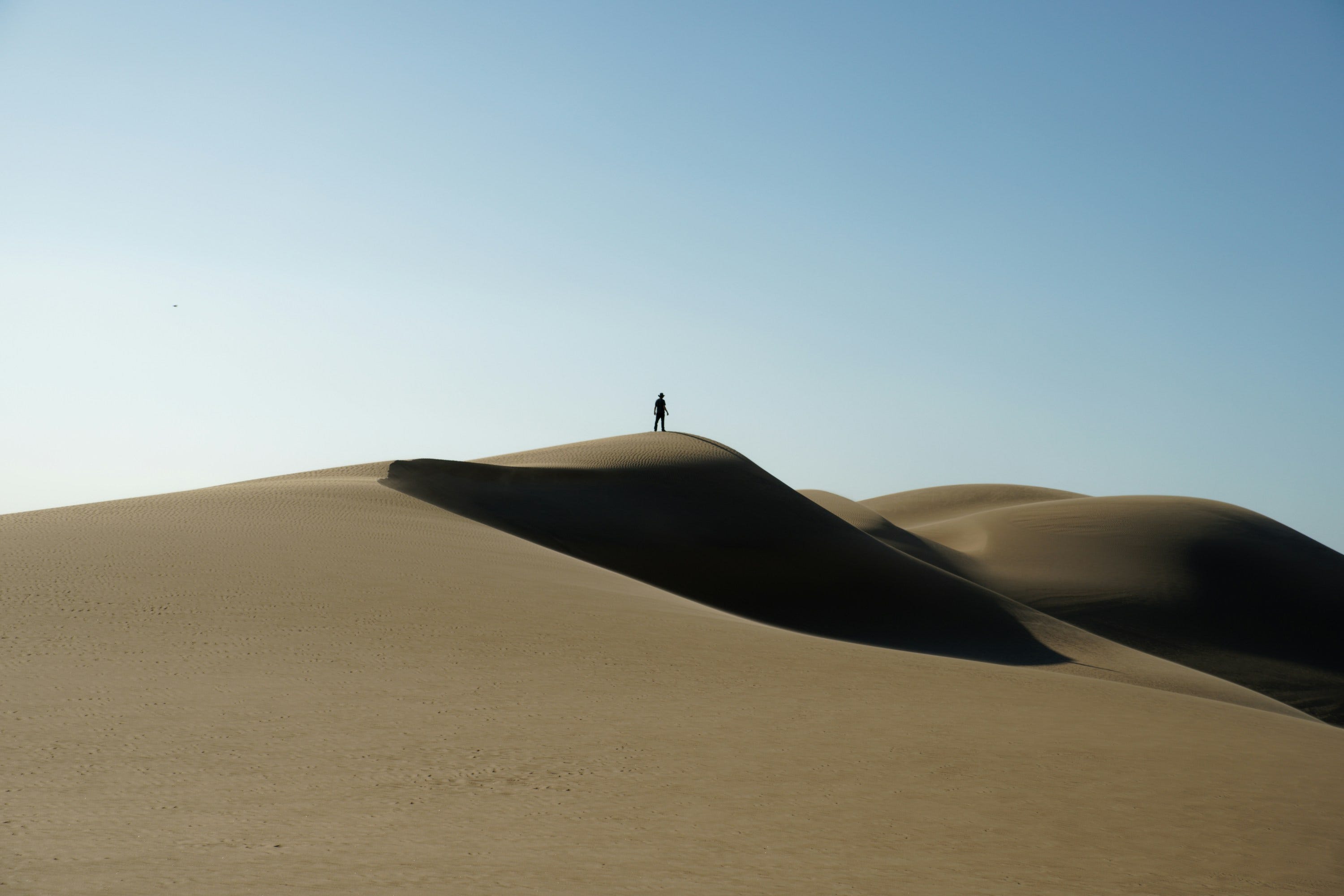
It’s Pesach this week. On Seder night, Jews all over the world sit together for the traditional feast, where the story of the Exodus scaffolds a night of storytelling and introspection across the span of Jewish history. The story of the night is one of high drama, including a villain (Pharaoh), an underdog (the Israelites), heroes (Moses, Miriam and Aaron), the supernatural (Ten Plagues), and the great escape (as the Israelites cross the Red Sea). The Exodus story takes up ~2% of the Torah, while the rest of it — almost 70% of the entire text — deals with the wandering after the initial climactic event. Last year, I read the weekly torah portion by myself every Saturday, and I was struck by the degree to which the Torah — the primary document and setting for what we today call the Jewish people — is really a story about a people wandering the desert.
The Exodus story understandably takes up most of the oxygen at the Seder, and the Exodus narrative dominates the origins of the West’s sense of itself. Stories with action and drama naturally capture one’s attention, and stories with linearity — a start (slavery), middle (struggle), and ending (freedom) — are inherently coherent and digestible. But a Big Bang — whether of the cosmos, of Western thought, or the creation of an identifiable people — is just that: a moment in time. Wandering may be less dramatic and sexy, and harder to follow given the implicit meandering and absence of a defined end, but it’s evidently where the sparks of the initial catalyst lead to the creation of something enduring. I think we’re all on the precipice of a period of wandering, and thinking about the upcoming Seder through this lens, instead of the usual motifs of slavery and liberation, helped me frame this particular moment in time. So let’s work through some brief examples to draw out my point.
The Jewish and Zionist worlds are in the midst of our own dramatic episodes. Since the cataclysm of October 7, the Jewish state has been beating back its enemies, and militarily, it has achieved enormous success: Iran and its proxies are massively degraded, leaving Israel as the undisputed regional military superpower. But when the bombs stop falling, the wandering must begin: with Israel’s standing in the world severely tarnished, how will it repair the damage to ensure it retains the strategic support that’s just as consequential to its future as its military alliances? How will it deal with large portions of the diaspora that have turned away from it in light of the costs of its wars, the violence its government continues to permit to be exacted on Palestinians, and the changes in the nature of its democracy? Like Exodus, wars are dramatic and (generally) have a beginning and end. But on the other side of the military achievements, with an election looming, is the wandering, where like the Israelites before them, Israel and its supporters will be forced to rearticulate what kind of country it wants to become.
Civilization at-large is also going through its own familiar story arc. In data centers dotted around the world, a new form of intelligence has emerged, and we’re being told that advances in said AI have us at the precipice of a future that’s hard to imagine. In some sense, we may therefore be at the Exodus moment of human history. For 300,000 years, Homo sapiens have been the apex intelligent beings on earth, and if the researchers are right, that may be about to change if AI relegates us back to the rest of the animal kingdom. We will soon have to transition from the excitement and possibility of a new technology, to living in a world where intelligence is no longer our defining and distinguishing characteristic. But in that world, who are we? What do we build our identity around and what does it mean to be human? I don’t have answers to these questions, but the uncertainty — the open, unmapped and somewhat threatening terrain — brings to mind the desert, and the texture of wandering.
And shifting from the big to the small, I feel like I’m in the early stages of my own personal wandering. The last decade of my life brought incredible opportunities and experiences, both personally and professionally. Three years ago, we started a family, and at some point in July, we’ll welcome another little homie to the crew. In my own way, I feel like I’m in my Exodus moment, leaving a life that largely belonged to me, for one that’s really focused on the new characters sprouting around me. From a family perspective, I’m still in the drama and excitement of toddlers and babies, but I understand that when I look back in (hopefully) many years time at a life (hopefully) well-lived, the dominant part of the story will be the one I’m on the cusp of beginning. And from a spiritual perspective, I’m beginning to understand that maybe I don’t know myself as clearly as I thought I did. With the benefit of some honest conversations with people I trust, I’m starting to appreciate that truly knowing myself is going to require sitting with questions or sensations I’ve previously been too busy, or too comfortable, to ask. A wandering if you will.
I imagine that for many of you reading this, “wandering” implies some level of negativity. And if so, I’d suggest that this is more of a reflection on our conditioning than the reality of wandering, because the wandering I’m talking about isn’t a gap between two places or moments. Instead, it’s where the work of becoming happens. If the idea of wandering creates some discomfort, it’s worth sitting with, because it’s arguably a clear signal that we inherently know — whether as humans, professionals, Jews or parents — that we’re looking out into a type of wilderness. One lesson of the Torah’s emphasis and structure is that what we become in the desert is more important than the drama that sends us there. The Jewish people’s sense of itself was built in the wilderness, a literal and figurative no-mans land, somewhere between Egypt and Israel, and somewhere between tribe, nation and people. In the Jewish context, wandering is therefore a productive, albeit challenging, endeavour. And it’s explicitly because wandering can be productive that I maintain real optimism for and conviction in Israel, the Jewish people, human nature, and importantly, myself.
The Exodus, the war, the technological innovation, and the new baby all feel like the story. But in reality, they’re arguably just the prequels, because history is made in what comes after. Rashi, one of the great medieval Jewish commentators, suggested that only 20% of the Israelites actually decided to leave Egypt in the Exodus, with the remainder choosing the familiar suffering of slavery over the unknown suffering of the desert. My take on this literary interpretation is that the 20% that decided to leave were the risk takers, those who gravitated towards the inherent uncertainty of wandering out of an understanding that the past had to be left behind. They would go on to Mount Sinai, where tradition holds that every Jew, including those of future generations, stood alongside the wanderers to receive the Torah and its commandments. That minority would then go on to the land of Israel, and eventually birth a people known as the Jews. The rest, as they say, is history, and it’s my history.
See you in the desert.
you are a amazing writer my friend, amazing.....................love receiving and listening to your magical interpretation of where you and our people are in life and in history. Chag Paseach Sameach to you and family xxxxx